
Emergency Air Duct Cleaning Near Me: What Syracuse Homeowners Should Do First
Most people searching for emergency air duct cleaning in Syracuse have already lived through something: a fire, a sewage backup, a rodent problem, a furnace that quit. The mistake we see most often is calling for a cleaning before anyone has identified what actually got into the ducts. Running the system in the meantime doesn’t just move that contamination around. It packs it into every branch of the ductwork and turns a manageable cleanup into a much bigger job. Here’s what to do in the first thirty minutes.
The short version: shut the system down, photograph everything, and get a real assessment before anyone quotes you a cleaning package. If that sounds like more than you want to sort through alone, call (833) 549-7193 and we’ll walk you through it.
Why the First 30 Minutes Matter More Than the Company You Call
Duct contamination doesn’t stay put. Smoke particles, sewage aerosols, rodent droppings and construction debris all behave differently once airflow pushes them through a system, and the longer the blower runs, the deeper they settle. Particles that would sit in a filter and a few feet of main trunk can end up coated along the full supply run, in the plenum, and on the evaporator coil. That’s the difference between cleaning the system and replacing half of it.
The first move in almost every Syracuse duct emergency is the same: stop the air handler. A system that’s off holds contamination roughly where the event left it. A system that’s running distributes it. The rest of the first thirty minutes is about knowing which scenario you’re in, because each one has a different correct response.
There’s a second reason timing matters. Insurance claims move on documentation, and the evidence you capture in the first half hour is often the evidence that gets the work covered. Odors fade. Filter dust gets bumped. Photos taken before anyone touches the system are worth more than any description afterward.
The Four Emergency Scenarios and What Each One Needs First
Emergency duct cleaning isn’t one service. It’s four very different situations that happen to share a search term, and the right first response changes completely depending on which one you’re facing.
1. Smoke and fire residue
Fire smoke leaves an oily, acidic film that settles on duct walls and anything else in the air path. Turn the HVAC system completely off at the thermostat and, if you can reach it safely, at the breaker. Don’t run the fan to “clear the air” – that’s the single fastest way to spread residue through a Syracuse home. Don’t run any window units or portable fans that pull air through the house either.
2. Sewage or water intrusion
A sewage backup or a flooded crawl space pushes contaminated moisture and aerosolized bacteria into the system. Again: full shutdown, not just the thermostat. Sewage carries pathogens, and circulating that air through bedrooms is the last thing anyone needs. If water reached the ductwork itself, don’t run the system at all until it’s been assessed and dried – moisture plus warm air is a mold problem waiting to happen.
3. Rodent or pest infestation
This one is more forgiving but still calls for shutdown. Rodent droppings carry real health risks and ducts are a classic highway for mice. Turn the system off, don’t sweep or vacuum near returns with a shop vac (that just aerosolizes the waste), and keep people out of rooms where you can smell or see activity. Full shutdown here, not circulation.
4. HVAC failure with debris
Sometimes the “contamination” is mechanical: a blower failure, a collapsed flex run, or debris pulled into the system after a renovation. Turn the system off until you understand what’s happening. In this scenario, circulating air is usually the least of the problem – the real answer is an HVAC repair tech, not a duct cleaner, and we’ll get to that below.
What to Document Before Anyone Touches the System
Whether or not you plan to file a claim, capture this in the first hour. It costs nothing and it makes an assessment far more accurate.
- Photos of the filter. Pull the filter and photograph both sides before you throw it away. Filter condition tells a specialist a lot about what’s been circulating.
- Photos of every register and return. Look for staining, dust patterns, or soot at the grilles.
- Note where the odors are strongest. A smell that’s worse at one return than another narrows down which part of the system took the hit.
- Photograph anything visible in the ductwork if you can safely remove a register cover without reaching in.
- Keep the damaged filter. Insurers and remediation specialists may want to see it.
- Write down the timeline. When the event happened, when you shut the system down, and when you noticed the odor.
Do not pull insulation or open duct joints to look inside. That’s a job for someone with the right equipment, and on a contaminated system, opening it up yourself can release what’s been contained.
Duct Cleaning vs. HVAC Repair: Which Specialist Do You Actually Need?
This is where a lot of Syracuse homeowners call the wrong company first, and it wastes the most time. Emergency duct cleaning removes contamination – smoke residue, sewage aerosols, rodent waste, debris. Emergency HVAC service fixes mechanical failure – a dead blower, a failed control board, a refrigerant problem.
If your system isn’t running at all, or is running but not heating or cooling, that’s an HVAC call. If it’s running fine but the air smells wrong or you know something got into the ducts, that’s a duct call. When both are true (say, a sewage backup flooded the air handler), the assessment usually comes first and determines which trade handles what.
Our scope is the duct ecosystem: cleaning, sanitizing, repair, sealing, and dryer vent cleaning. We’re specialists rather than general HVAC repair contractors, and being honest about that distinction is the whole point – a mechanical failure needs a mechanical fix.
What a Real Emergency Duct Assessment Looks Like
When a specialist arrives, the first thing they should do is assess, not sell. If someone shows up, glances at a register, and quotes you a cleaning package inside five minutes, that’s a sales call. A genuine assessment looks different.
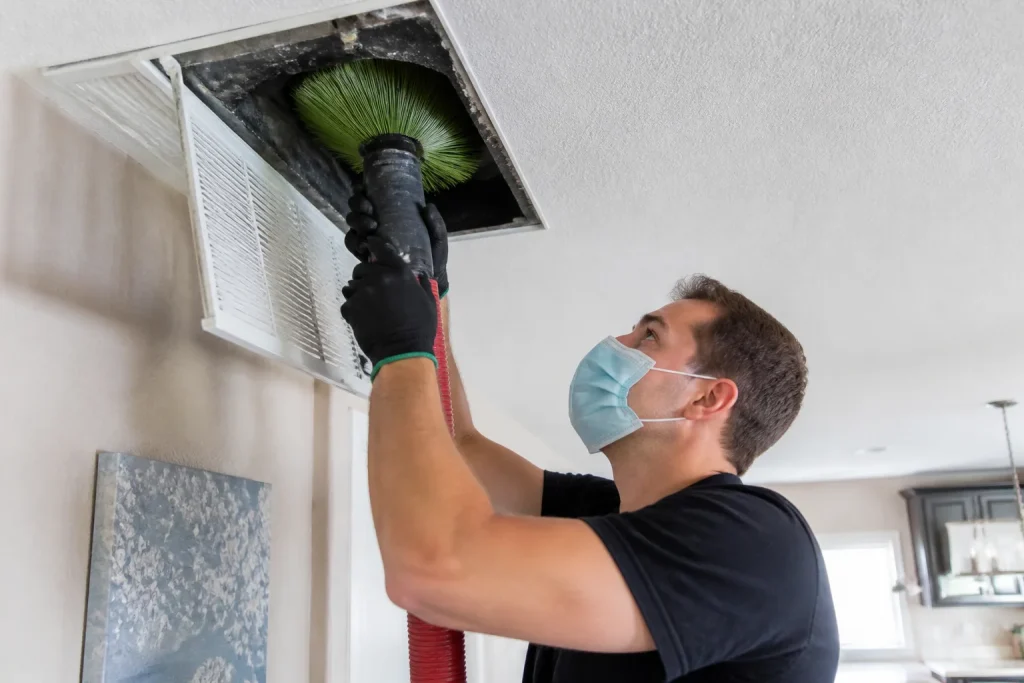
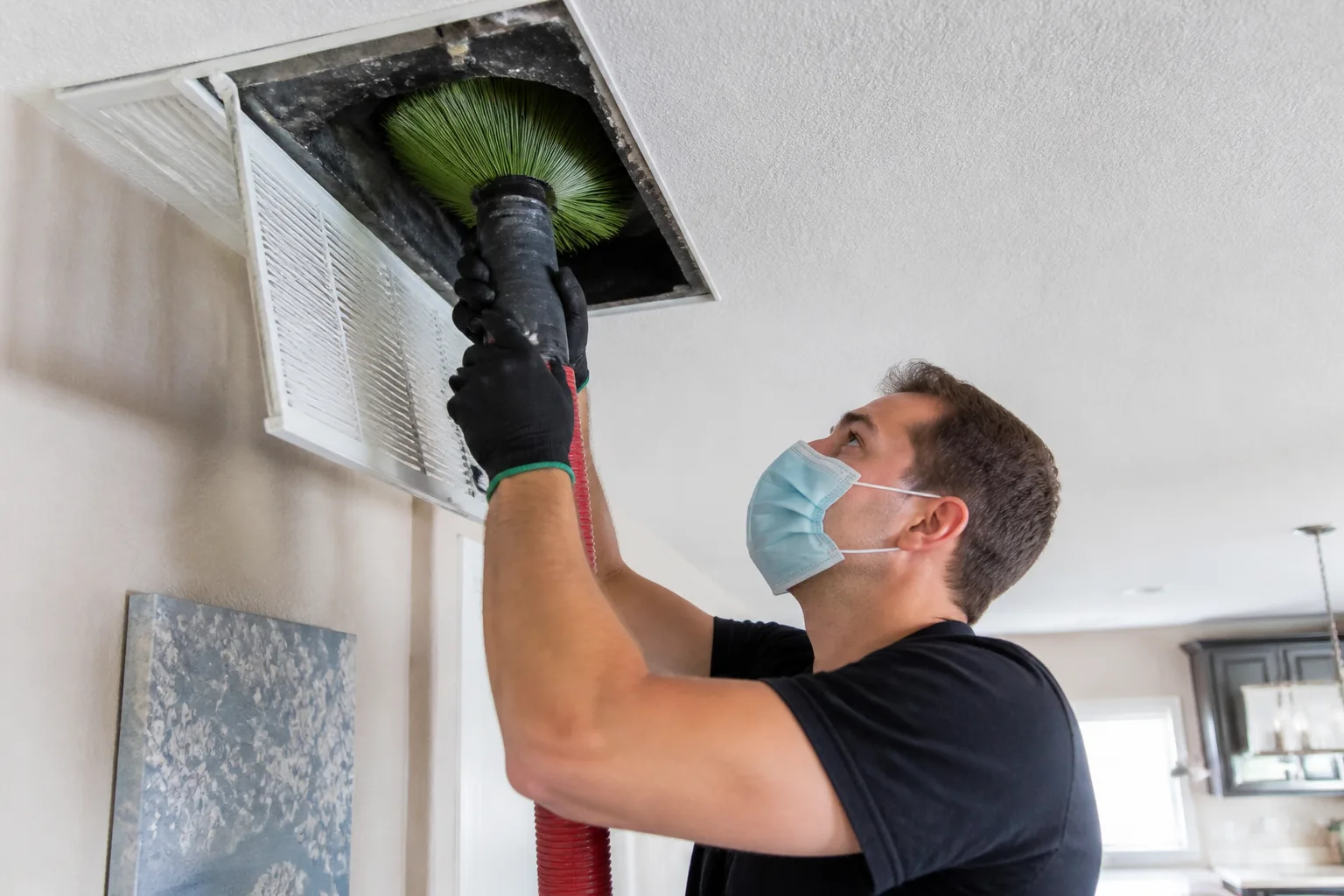
It starts with questions: what happened, when, did the system run afterward, what can you smell and where. Then a visual inspection of the air handler, the filter, the plenum, and accessible duct runs. On a smoke or sewage job, any competent crew opens with containment – we deploy Abatement Technologies air filtration units to capture dislodged debris instead of redistributing it through the house. Cleaning itself uses contact-vacuum equipment like Rotobrush brush systems, which agitate and capture along the duct walls rather than just pulling air. That’s professional-grade equipment, not a shop-vac shortcut, and it’s the difference between a clean system and a system that looks clean at the registers.
You should get a written scope before any work begins – what’s being cleaned, what’s being sanitized, what’s being sealed, and one flat price for the job.
When to Call a Pro (and What to Have Ready)
If you’ve had a fire, a sewage backup, a rodent problem, or a system failure, call. Duct contamination isn’t a wait-and-see situation, and the longer the system runs, the more it costs to fix. If you’re a renter, loop in your landlord before anything is scheduled. If you’re filing a claim, tell the specialist up front so they can document accordingly.
Have your photos ready, know roughly what happened and when, and mention if anyone in the home has respiratory issues. Our technicians have up to 12 years of experience with exactly these situations in Syracuse.
Related services in Syracuse: for the full scope beyond emergency response, see air duct cleaning and HVAC cleaning. If drying performance has dropped or you haven’t had the vent checked, our dryer vent cleaning service is worth scheduling at the same time.
The Bottom Line
Emergency duct contamination is about knowing which scenario you’re in before anyone touches the system. Shut the air handler off, photograph everything, and get a real assessment before you agree to a cleaning. If your system has a mechanical failure, call an HVAC repair specialist – duct cleaning won’t fix a dead blower. If contamination got into the ducts, that’s our lane.
If you’re in Syracuse and need help, Syracuse Air Duct Cleaning Pros offers free estimates – call (833) 549-7193. We answer 24/7, with fast dispatch from 7am to 7pm, Sunday through Friday.
Frequently Asked Questions
Immediately. Turn the system off at the thermostat and, if you can reach it safely, at the breaker. Running the air handler after smoke or sewage exposure pushes contaminants deeper into every duct run and makes remediation significantly more expensive. Once it’s off, call (833) 549-7193 for an assessment – estimates are free.
No. Pricing is set per job by a written estimate, and the estimate is free. What changes after a fire or sewage event is the scope – sanitizing and sealing usually get added – not a premium for the timing. Get the written scope before work starts so you know exactly what’s included.
No. Running the fan is exactly what spreads contamination through the system. Turn it completely off. For smoke, sewage, or rodent situations, the system stays off until a specialist assesses it. Airing out rooms with open windows is fine; circulating air through the ducts is not.
Often, yes, when the cause is a covered event like a fire, sudden water damage, or pest infestation. That’s why documentation matters – photos of the filter, registers, and odor locations, taken before anyone touches the system. We can work with your insurer on the claim paperwork. Call (833) 549-7193 and we’ll tell you what to capture first.
Written by the team at Syracuse Air Duct Cleaning Pros.
Need Air Duct Cleaning Help?
Call Syracuse Air Duct Cleaning Pros - the local pro we connect you with is licensed and insured, here with fast help in Syracuse.
(833) 549-7193