
Top Signs You Need Air Duct Cleaning Service – Don’t Ignore These
The signs you need air duct cleaning in Syracuse, UT aren’t as obvious as a dusty vent cover. Dust on the furniture, a musty smell, rooms that heat unevenly – each one has a duct-specific cause and at least two other causes that have nothing to do with your ducts. Reading the symptom wrong means paying for cleaning that fixes nothing, or skipping cleaning you genuinely need. This guide is the diagnostic logic we use in the field. If you’d rather skip the detective work, call (833) 549-7193 and we’ll sort it out with you.
What Are the Real Signs Your Ducts Need Cleaning?
The strongest sign is debris you can actually see or smell coming from the ducts, not just dust in the room. A close second is a musty or stale odor that shows up when the system first starts. A third is fine grit or debris collecting at the supply registers. Each of these points at contamination inside the air path.
Here’s where most homeowners get tripped up: the same dusty-room symptom can come from a cracked heat exchanger, a failed duct seal, or a dirty blower wheel. Cleaning won’t fix any of those. It’s the like treating a leaky roof with a fresh coat of paint – the paint dries, the leak doesn’t.
Use this rule of thumb when you’re unsure:
- Debris visible at more than a couple of registers, or a persistent odor from multiple vents: this is duct contamination, and it’s worth a look at your full air pathway.
- Dust on every surface after the system starts, but no smell and no visible vent debris: often a seal or blower problem. Have an HVAC tech check before booking a cleaning.
- Odor from just one room, and only when the system runs: more likely a localized return or a sealing issue in that branch, not whole-system contamination.
It’s not a bad thing to be wrong about which symptom means what. It’s a bad thing to pay for the wrong service. A careful look before you book saves a lot of regret.
Dusty Surfaces, Musty Odors, and Uneven Rooms: What Each One Is Really Telling You
Each common “my ducts are dirty” complaint has one duct cause and, usually, one or two HVAC causes that mimic it. Sorting them is the difference between a clean system and a clean bill of health.
Dust on surfaces
The duct cause: escaped debris from a compromised duct run or an under-filtered return. The HVAC causes: a dirty blower wheel throwing dust back into the stream, or a failed seal at a joint you can’t see. Cleaning fixes the first. You need an HVAC tech for the second.
Musty odor
The duct cause: moisture in the air path, most often from a damp return or an unsealed joint where condensation collects. The HVAC cause: a clogged condensate drain or a coil that’s staying wet and never drying out. Cleaning helps only once the moisture source is found.
Uneven heating and cooling
The duct cause: a return or supply branch partially blocked by debris or a collapsed section of flex. The HVAC cause: a failed damper, a furnace that’s short-cycling, or a poorly sized system. Cleaning a clogged branch helps. Cleaning a system with a damper problem does nothing.
Visible debris at registers
The duct cause: the supply side pushing debris out, or the return side pulling it in where a boot isn’t sealed. Which side it’s on is what matters. Debris at every supply register usually points to contamination on the supply side. Debris clustered at one or two returns points to the return run. See the inspection method below to tell them apart.
Allergy flare-ups in the home
The duct cause: accumulated debris and biological growth giving airborne particles a foothold. The HVAC cause: a filter frame that doesn’t seal, so unfiltered air bypasses the filter entirely. Cleaning helps when the ducts are the source. A filter upgrade and seal helps when the filter frame is the source.
If you’ve checked a couple of these and the pattern still points at the ducts, that’s the right time to call us. If it points at the furnace or the seals, call an HVAC tech first – we’d rather you get the right answer than the wrong one.
The Register Inspection You Can Do This Weekend
You can tell a lot about your ducts with a flashlight and one white tissue. Here’s how to check your own registers without guessing.
- Turn the system off. Wait for the fan to stop. You need still air to see what’s actually settled.
- Shine the flashlight into the supply register. Look at the first few inches of ducting behind the grille. Fine, even dusting is normal aging. Clumps, grit, or a matted layer are contamination.
- Hold the white tissue just in front of the supply register and turn the fan on. A faint, even flutter is normal. A gray film building on the tissue quickly or visible flecks landing on it is a supply-side sign.
- Repeat at a couple of return grilles. Returns pull air in and soil faster than supplies. Dark streaking on the return-side duct walls is often where the real load sits.
- Write down what you see per room. A pattern across every vent tells you it’s whole-system. A pattern at one vent tells you it’s localized.
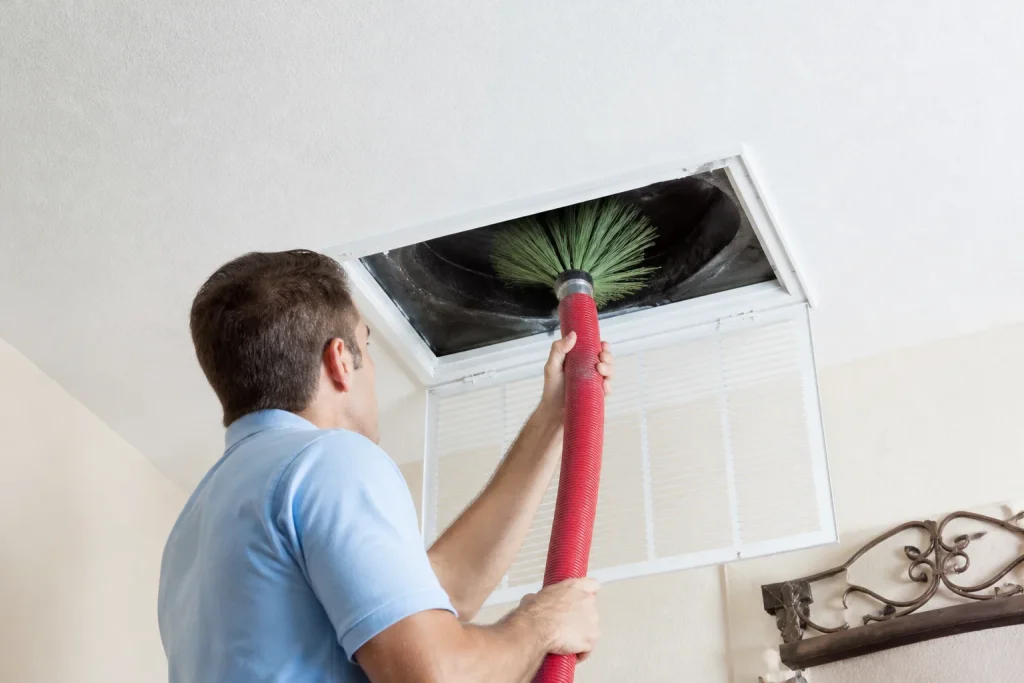
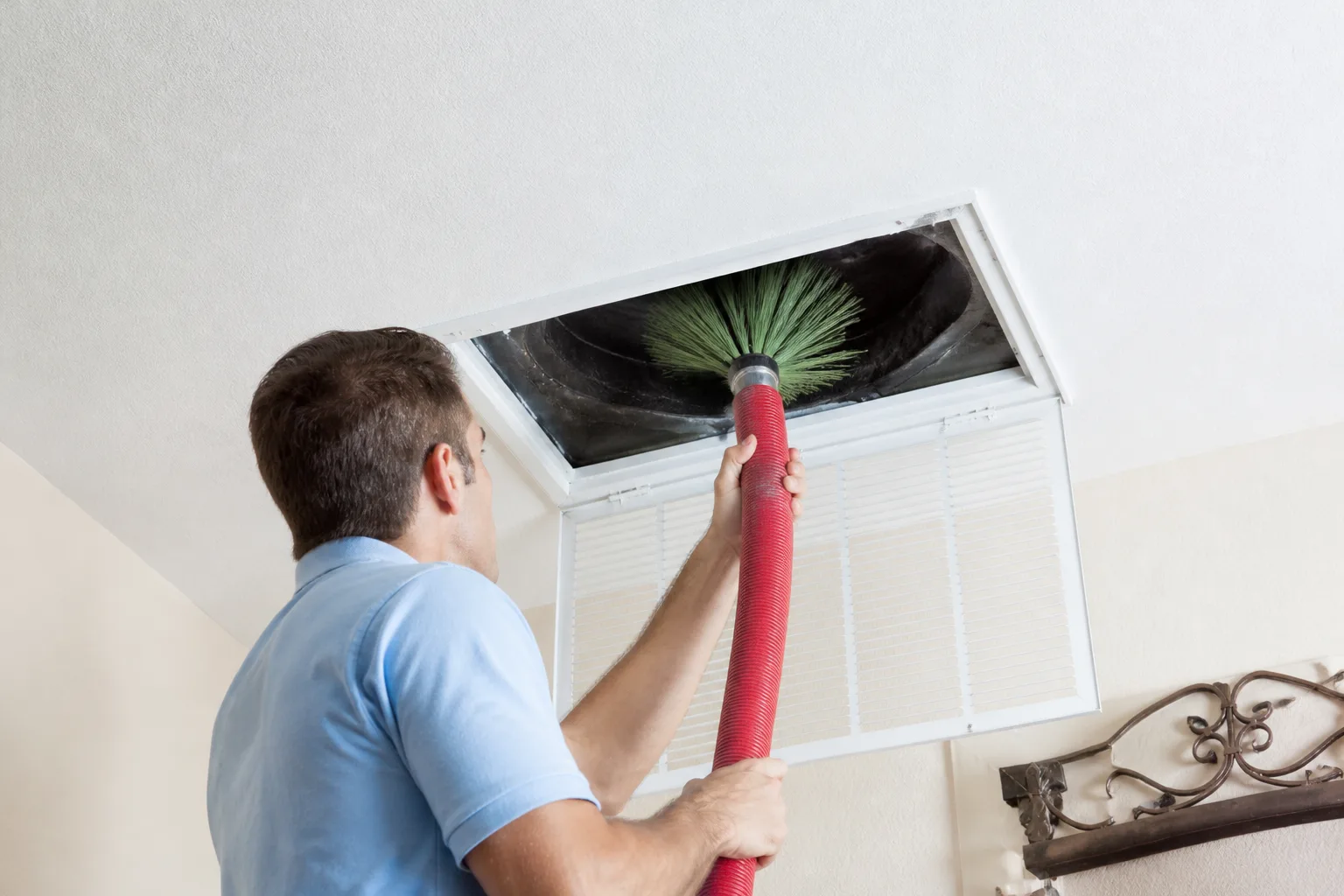
The key distinction is supply side versus return side. A homeowner who can tell those apart has already done the assessment for the technician, and that usually shortens the visit. Our air duct cleaning service covers the full air path, both sides, so what you find informs what we do – not the other way around.
One safety note while you’re looking: never run the system while you have a register cover off and dust blowing, and never put your hand into a duct past the boot. Moving blower wheels and sharp sheet-metal edges are real hazards. A trained professional has the right tools to look further in.
Acute Contamination Events: When “Dusty” Becomes “Call Now”
Normal duct aging is even, gradual, house-wide. A contamination event is sudden, localized, or paired with something that needs a professional response.
- Rodent activity. Droppings, chewed flex, or a nest near an accessible run is not routine dust. This needs professional handling with containment – not a shop vac. The health concern is real and the spread risk is high if you disturb it.
- Moisture intrusion. Water staining near a vent, or a musty smell that appeared after a leak or a humid stretch, points to moisture in the air path. Moisture is a growing condition for biological growth, and cleaning is only half the answer; the moisture source has to be fixed first.
- Construction debris. Drywall dust, sawdust, and plaster grit from a renovation can settle into ducts and get pushed through the home for months. In Syracuse and across Davis County, new construction and remodels are routine, and post-renovation cleaning is one of the most common reasons homeowners call us. If you’ve recently had work done and the dust hasn’t settled after a few weeks, that’s a sign.
- Wildfire smoke infiltration. Northern Utah’s wildfire season pushes smoke into homes through returns and gaping filter frames. The smell lingering after the smoke clears, or visible ash coating return-side duct walls, is a duct issue, not just a window issue.
- Hard-water mineral deposits. Homes with a whole-house humidifier on Utah’s hard water can build mineral scale in the ducting near the humidifier tie-in. That’s not dust; it’s a crust, and it needs a different clean than a standard vacuum pass.
Any item on that list puts you in “call now” territory. The rest of the signs on this page are usually “schedule a routine cleaning” if they persist. If it’s an HVAC equipment concern, we’d rather you call a qualified HVAC technician first and then book the cleaning – in that order. Our HVAC cleaning service handles the equipment-side cleaning once the repair is done, so the system is clean top to bottom.
When Should You Book Routine Cleaning, and When Should You Call an HVAC Tech First?
The honest answer is: most homes don’t need duct cleaning every year. Routine cleaning makes sense when several of the softer signs show up together – visible dusting, a faint odor on startup, a pattern across multiple rooms – or you’ve just finished a renovation or bought a home where the previous owner’s care is unknown.
Here’s the decision framework we use. Read across until a line fits your situation.
| Symptom pattern | First call |
|---|---|
| Visible debris at multiple supply registers, odor on startup, dust across the house | Schedule routine cleaning |
| Evidence of rodent activity, moisture staining, or a musty smell after a leak | Call now – professional assessment |
| Construction or remodel recently finished, dust still settling | Schedule cleaning |
| Smoke smell lingering after wildfire season | Schedule cleaning |
| Uneven heating, short-cycling furnace, or dust with no visible vent debris | HVAC tech first, then cleaning |
| Dust only from one vent, no odor, one room | Check the register first, likely a localized seal issue |
And a note about the dryer: if your clothes take longer than they should to dry, or the vent flap outside the house barely moves when the dryer runs, that’s not an HVAC sign at all. It’s lint buildup in the exhaust run. Standalone dryer vent cleaning is one of the most overlooked safety services in any home, and we handle it as its own visit because a clogged dryer vent is a fire risk, not just a slow dryer.
The Bottom Line
Most homeowners who think they need duct cleaning actually need one of three things: a duct cleaning, an HVAC repair, or a seal job. Reading your symptoms accurately is the whole game. Here’s the short version:
- Visible debris at multiple registers, a musty smell on startup, dust throughout the house, or lingering post-renovation grit: schedule cleaning.
- Rodent signs, moisture intrusion, or a musty smell after a leak: call now for professional assessment.
- Uneven heat, short-cycling, or dust with no vent evidence: call an HVAC tech before cleaning.
- Slow dryer, flap that barely moves: that’s a dryer vent issue, call for that separately.
If you’re in Syracuse and need help, Syracuse Air Duct Cleaning Pros offers free estimates – call (833) 549-7193. We use Rotobrush contact-vacuum equipment and Nikro negative-air machines so we contain what we dislodge instead of pushing it through the house. And if what you describe sounds like an HVAC repair rather than a duct problem, we’ll tell you that too. Getting the right answer is more important than booking the visit.
Frequently Asked Questions
Shine a flashlight into your supply registers and hold a white tissue in front of one while the fan runs. Fine dust is normal aging; clumps, grit, or a quick gray film on the tissue points to contamination. Compare supply and return registers – returns often hold the heavier soil. If the pattern shows up across multiple vents, call (833) 549-7193 for a free estimate.
They can contribute, especially when debris, rodent residue, or moisture-driven growth accumulates in the air path. But allergy symptoms have many sources, and a leaky filter frame or an unsealed return can contribute too. If cleaning is the answer, it should include the full air path, both supply and return sides. Call (833) 549-7193 and we’ll walk through it with you.
For most homes, every three to five years is reasonable if the signs above are mild. After a renovation, a new home purchase, or a wildfire season that pushed smoke inside, an earlier cleaning is worth considering. There’s no one-size rule – your register inspection is the better gauge. Call (833) 549-7193 for an honest assessment, free of charge.
It’s a separate service and a separate safety concern. Long dry times or a barely-moving outside flap usually mean lint buildup in the exhaust run, not an HVAC duct problem. We treat dryer vent cleaning as its own service for that reason. If you’re not sure which one you need, call (833) 549-7193 and describe what you’re seeing.
Our technicians have up to 12 years of experience, and we deploy Abatement Technologies air filtration devices during service to protect indoor air quality while work is in progress. When the job calls for an air-quality upgrade, we can install Honeywell and Aprilaire components – bridging the gap between cleaning and long-term air improvement.
Call (833) 549-7193. We answer 24/7. Fast dispatch from 7am to 7pm, Sunday through Friday.
Written by the team at Syracuse Air Duct Cleaning Pros.
Need Air Duct Cleaning Help?
Call Syracuse Air Duct Cleaning Pros - the local pro we connect you with is licensed and insured, here with fast help in Syracuse.
(833) 549-7193